Endovascular Intervention Tool Segmentation and Collision Detection
CATHACTION Workshop @MICCAI2026
Introduction
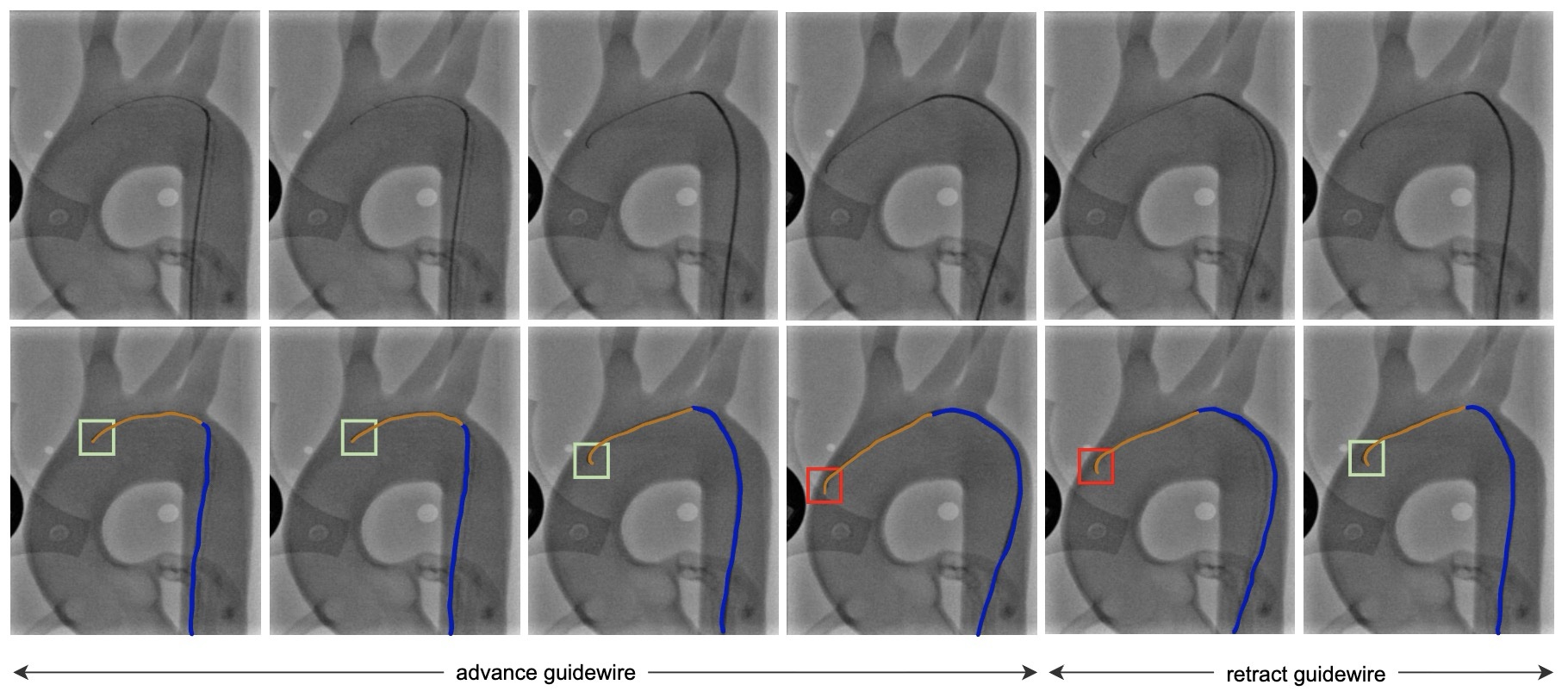
Cardiovascular disease remains one of the leading causes of mortality worldwide. Minimally invasive endovascular interventions have emerged as the standard of care due to reduced trauma, lower complication rates, and faster post-operative recovery compared to traditional open surgery. However, navigating catheters and guidewires through the vasculature demands highly specialized skills; unintended collisions with vessel walls can result in perforation, hemorrhage, or life-threatening complications. Although recent advances in surgical AI have shown promise, progress in endovascular assistance is limited by the absence of large, diverse, and clinically realistic datasets for benchmarking algorithmic performance. To address this need, we present CATHACTION, a new multi-task MICCAI challenge designed to advance surgical perception and intraoperative support for endovascular interventions. CATHACTION provides over 600,000 frames, making it one of the largest datasets in this domain. Critically, the data come from three distinct collection environments: (1) silicon phantom training systems, (2) animal X-ray fluoroscopy, and (3) real human X-ray procedures, yielding rich variability in image appearance, anatomy, and instrumentation. This unique multi-domain coverage enables the study of domain generalization, domain adaptation, and transfer learning, all of which are essential for deploying ML systems in real clinical settings. The 2026 MICCAI CATHACTION Challenge will focus on on two core tasks: 1) Tool Segmentation and 2) Collision Detection. Participants are encouraged to exploit the multi-domain nature and scale of the dataset, and to investigate models capable of cross-domain generalization, joint learning, or foundation-style representations.
Submission Guidelines
Participants must submit their final method as a Docker container. The container should include the trained model, inference code, model weights, preprocessing, post-processing and all required software dependencies. The organisers will run the container on a hidden test set. Internet access will not be available during evaluation.
Input
For each test case, the input image will be available at:
/input/image.nii.gz
The image format and structure will be consistent with the training data.
Output
The container must save the predicted segmentation at:
/output/segmentation.nii.gz
The output must:
have the same image size and spatial information as the input; contain integer segmentation labels; follow the challenge label definitions; contain only one segmentation file; and be generated automatically without manual input.
For example:
0 = Background
1 = Target structure
2 = Second structure
The final output must be a hard segmentation mask, not probabilities or logits.
Running the Container
The organisers will run the submission using a command similar to:
docker run --rm \
--network none \
--gpus all \
-v /host/input:/input:ro \
-v /host/output:/output \
team_algorithm:latest
The container must start inference automatically and stop after producing the output.
Technical Requirements
The container must: run on Linux using the amd64 architecture; work without internet access; include all required model weights and dependencies; not require any command-line arguments;
write the final result to /output/segmentation.nii.gz;
and complete within the announced runtime and memory limits.
Submission File
Participants should export their Docker image using:
docker save team_algorithm:latest | gzip > team_algorithm.tar.gz
The file should be named:
TEAMNAME_algorithm.tar.gz
Validation
Before submission, participants should confirm that: the container runs successfully; the output file is created; the segmentation has the same dimensions as the input; the output contains only valid class labels; and the method works with internet access disabled. Submissions that fail to run, exceed the resource limits or produce an invalid output file may receive a score of zero for the affected test cases. Participants must also provide a short description of their method and declare any external datasets or pretrained models used.
Technical Report
All participating teams will submit a brief methodology report in MICCAI format (maximum 4 pages) describing their approach. The top-performing teams will be invited to contribute to a joint challenge publication. Each invited team may nominate up to two representatives as co-authors. Authorship will follow standard academic contribution guidelines. The organizers intend to submit the joint challenge paper within approximately 6–8 months after the challenge. Participating teams are free to publish their methods and results independently. However, teams are requested to appropriately cite the challenge description and dataset paper. To ensure coordinated dissemination of the official test set results, a short embargo period of up to 3 months after the challenge event will apply to publications that rely primarily on the unpublished test set results. After this period, participants may freely submit and publish their work.
Important Dates (Paris / Pacific Time Zone)
| Workshop challenge announced | July 15 |
| Challenge submission deadline | Aug 15 |
| Technical report submission deadline | Aug 20 |
| Notifications to challenge winners | Sep 1 |
| Challenge date | Oct 1 |
Dataset
| Training and validation data | Download link and more details about the data |
| Final result submission portal | Open on Aug 10 |
Organizers

University of Liverpool

University of Florida

MBZUAI

Imperial College London

Case Western Reserve University

University College London

University College London

University of Liverpool
Contact
To contact the organizers please use Baoru.Huang@liverpool.ac.uk
Acknowledgments
Thanks to visualdialog.org for the webpage format.